
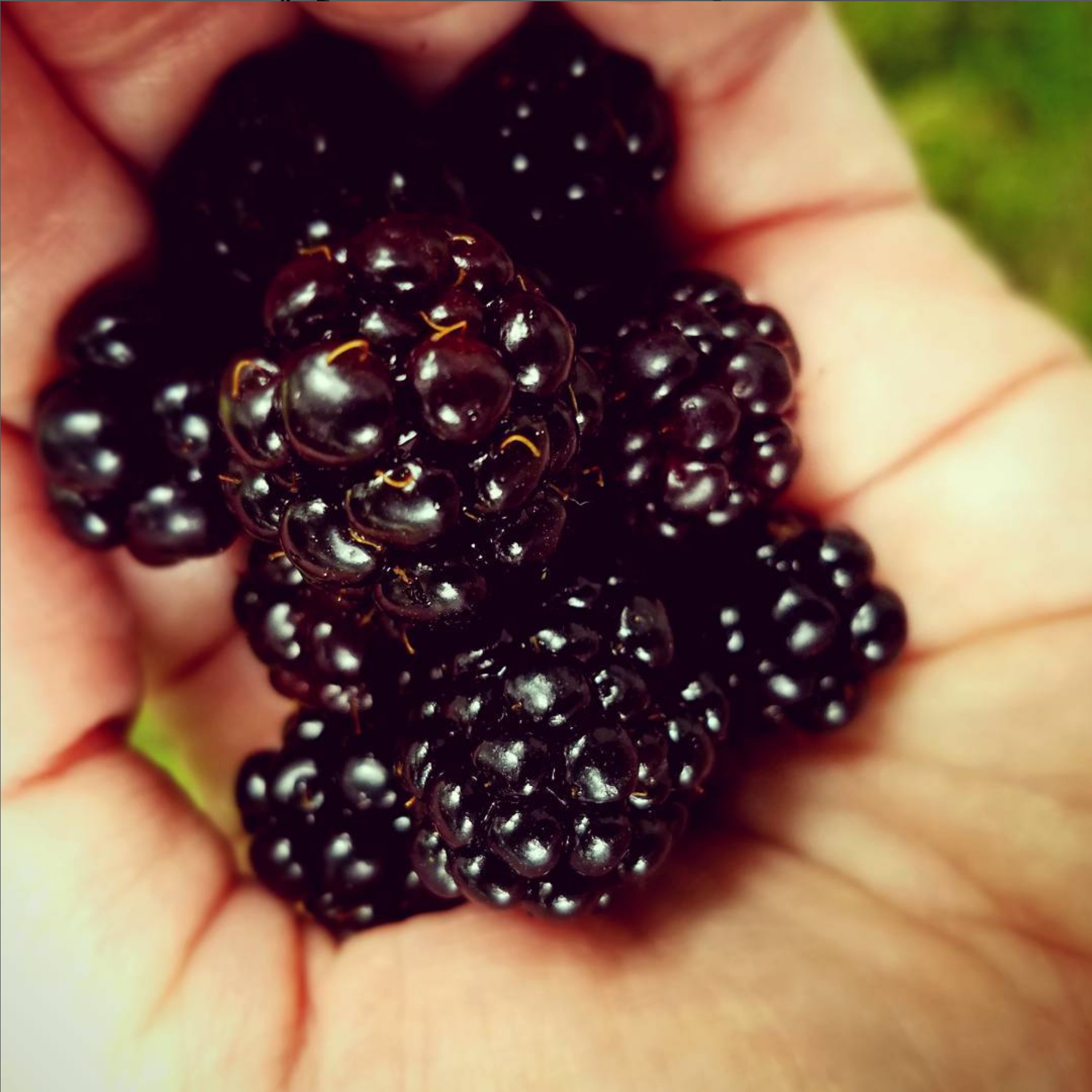
As I look at predicted overnight lows in the 20s for the next few days, I try to think warm thoughts. Summer in New England is my go-to for balmy reflections, which brings to mind my favorite summer fruit: the blackberry, the very expression of summer. When I see the first blackberry flower of the year, I immediately think of warm, carefree, sunshiny days.
Blackberries are perennial fruiting bushes. The canes growing above ground are green the first year, coming up after the previous year’s canes have finished producing fruit. The next year, these first-year canes will produce fruit then die, to be replaced by new, green canes.
As a child, picking blackberries was a rite of summer. Something about finding wild food that was safe to eat was innately appealing to us. Growing up in eastern Massachusetts, wild blackberry season was mid-July to mid-August, during the prime of summer vacation – before thoughts of returning to school in September had begun to cross our minds. Here in Arkansas, blackberries ripen earlier from late May through June.
 The blackberry belongs to the genus Rubus, family Rosaceae. Small, fragrant white flowers resembling miniature wild roses are followed by berries that are first green, then red, and finally ripen into a deep, purply black.
A lifetime of picking and eating blackberries has taught me this: only pick the blackest berries. If a berry has any bit of red on the fruit, it will be sour. Even the ripest blackberries have a pleasant tang to them. But a berry that is even slightly less than ripe is not worth eating.
Blackberries are native to five continents – all but Australia and Antarctica. As for cultivated blackberries, many varieties are available, including thornless varieties that were first cultivated in the 1920s.
 I have never knowingly eaten a blackberry from a thornless plant, but I suppose the ones I’ve bought at the supermarket could have been thornless. Why wouldn’t they be? Easier to harvest, right? But the delicate work of gently picking blackberries while avoiding (or at least trying to avoid) being stuck by thorns is half of what makes the resulting yield so delicious.
I’ll note here that the blackberries I buy at the grocery store (thornless or not) are never as flavorful as the thorny ones I’ve grown in my backyard or foraged in wild-ish undeveloped or overgrown places. Maybe the superior flavor or thorned blackberries is due to the blood sacrificed in their harvesting?
The Old Farmer’s Almanac recommends planting blackberries in a sunny location, in fertile soil that has good drainage and plenty of organic matter added.
Which reminds me exactly of the favorite spot my childhood running buddy, Diane, and I would pick blackberries every summer: the cemetery. It meets all the almanac’s recommended qualities. (We never questioned what organic matter made the bushes there grow so large.)
From the age of about 8 until we reached junior high and got interested in other things, Diane and I would walk to the cemetery* as soon as the first berries were ripe (I don’t know how we knew when that was). We’d arrive laden with all sorts of empty vessels: glass mayo jars, Cool Whip containers, margarine tubs and maybe even a Tupperware if we promised not to lose it. We’d return home with scratched-up arms and legs, red-stained lips and fingers, and tons of berries in containers and our bellies. We’d have blackberries in pies, on cereal, with ice cream, and topping shortcakes, until summer was over, and it was time to go back to school.
 Right now, it’s cold and gray outside. Rain has been falling for most of the day, with half an inch of ice expected overnight. It’s still a few months from blackberry season, so I’ll just have to layer on the sweaters and keep thinking my happy, summer blackberry thoughts.
*You might be wondering who would let children walk to the cemetery by themselves. The answer is, almost every parent. This was in the 1970s, the next-to-last decade of the free-range child.